
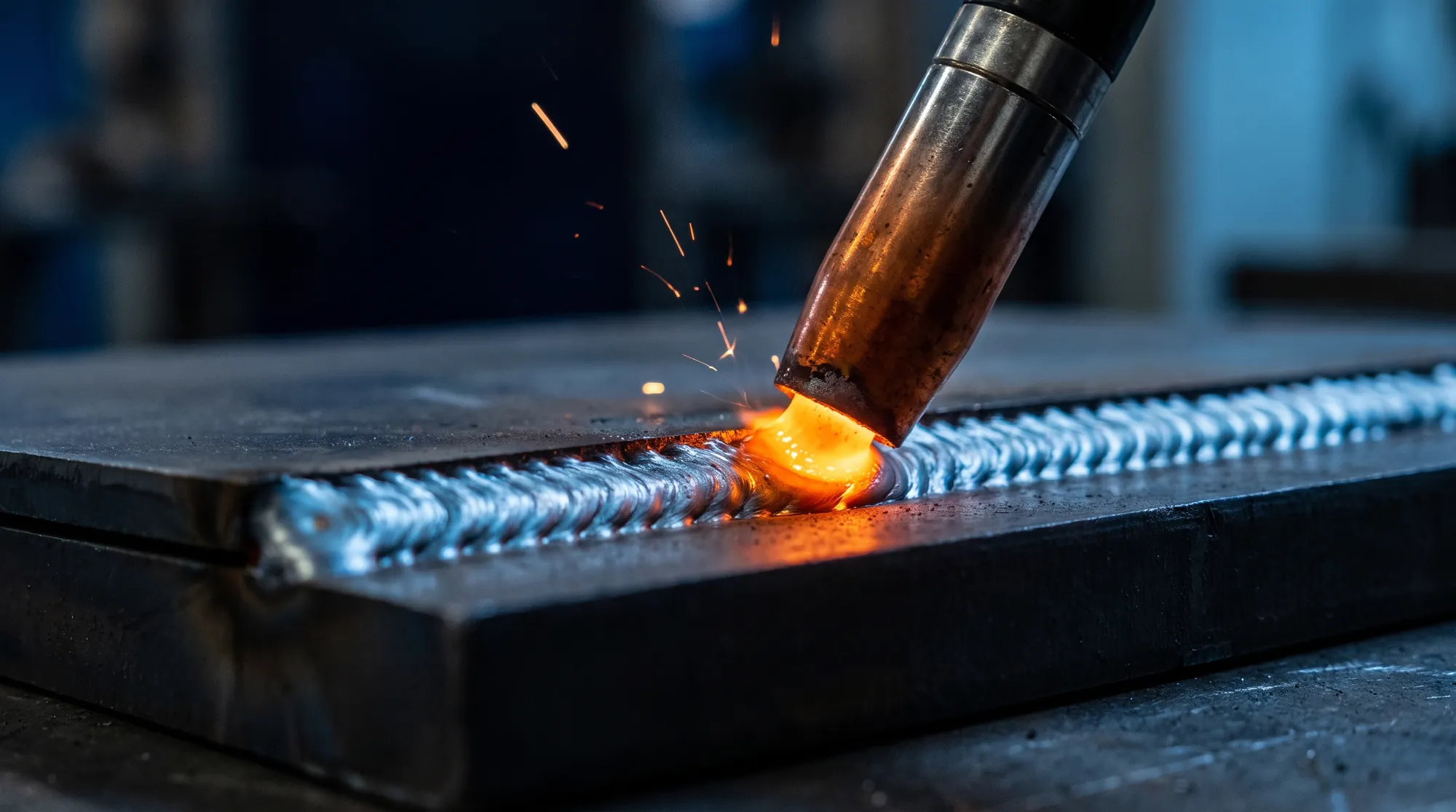
Gas metal arc welding is an arc-welding process in which an electric arc between a continuously fed wire electrode and the workpiece melts and joins the metal under a protective gas atmosphere. Internationally it is known as GMAW (Gas Metal Arc Welding); depending on the gas used it is called MIG or MAG welding.
How does MIG/MAG welding work?
The power source supplies the current and voltage for the arc. The wire feeder pushes wire from a spool to the torch at a constant speed. Current is transferred to the wire at the contact tip and an arc forms between the wire and the workpiece. At the same time, shielding gas flowing from the torch protects the molten weld pool from oxygen and nitrogen in the air.
- Power source: converts mains power into suitable welding current and voltage.
- Wire feeder: feeds the wire at a constant, controlled speed through drive rolls.
- Torch and cable assembly: carries wire, current and gas to the weld.
- Shielding gas: protects the weld pool and shapes the arc characteristics.
The difference between MIG and MAG
Both processes use the same equipment; the difference is the shielding gas.
| Process | Gas | Typical application |
|---|---|---|
| MIG (Metal Inert Gas) | Inert gases such as argon or helium | Aluminium and non-ferrous metals |
| MAG (Metal Active Gas) | CO₂ or argon–CO₂ mixtures | Carbon and low-alloy steels |
In most workshops the most common application is MAG welding of carbon steel. Argon–CO₂ mixtures give less spatter and a neater bead, while pure CO₂ offers deeper penetration and lower cost.
Advantages of MIG/MAG welding
- High productivity: the wire is fed continuously, so there are no electrode changes.
- Clean welds: no slag, minimal post-weld cleaning.
- Easy to learn: quicker to master than stick (MMA) welding.
- Versatile: from thin sheet to heavy structures, in every position.
- Automation-ready: easily adapted to robotic and mechanised welding.
Choosing the right machine
Success in MIG/MAG welding starts with the right current capacity, a suitable cooling type and stable wire feeding. Compact machines with an integrated wire feeder are sufficient for thin sheet, while thick plate and long seams call for high-current machines with a separate wire feeder and water cooling.