
A poorly chosen welding machine either breaks down from working beyond its capacity or creates unnecessary investment and energy costs because it is far larger than needed. The steps below will help you choose the right MIG/MAG welding machine for your work.
1. Determine the material thickness
Material thickness is the most important factor in the welding current you need. As a general guide:
- Thin sheet and workshop jobs: compact machines in the 215–250 A class
- Medium plate, intensive workshop use: machines in the 350–400 A class
- Thick plate, heavy structures, multi-shift production: water-cooled machines in the 450–550 A class
Exact values depend on joint preparation, number of passes and welding position.
2. Check the duty cycle
Duty cycle shows how long the machine can weld continuously at a given current within a 10-minute period. All Eurotech machines are rated at a 60% duty cycle, meaning they can weld at rated current for 6 minutes out of 10. For long seams and series production, consider current capacity and duty cycle together.
3. Check your electrical supply
Most professional MIG welders run on a 380 V three-phase supply. If you do not have three-phase power, choose a 220 V single-phase model. The machine's power consumption (kVA) and recommended fuse rating must match the capacity of your distribution board.
4. Choose the cooling type
Above roughly 350–400 A and during long welds, the torch heats up quickly. Water-cooled systems then extend the life of the torch and consumables and improve operator comfort. For lower currents and intermittent use, air-cooled machines are sufficient. See our water-cooled vs air-cooled comparison for details.
5. Decide on the wire feeder configuration
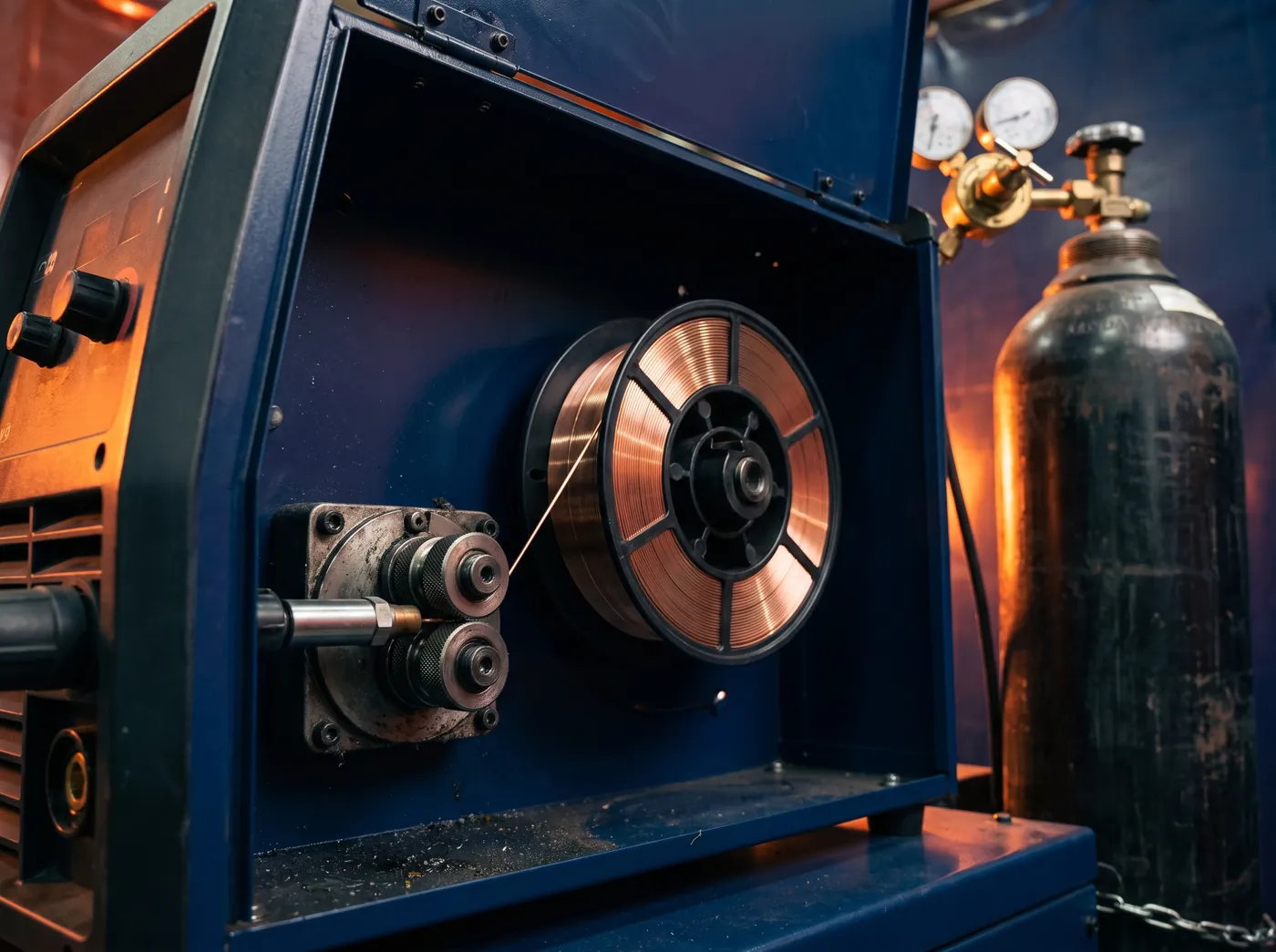
- Integrated wire feeder: compact and portable; ideal for workshop and thin-sheet work.
- Separate wire feeder: gives the operator flexibility on large workpieces and wide working areas; preferred in heavy industry.
6. Ask about service and spare parts
A welding machine is a long-term investment. Fast availability of spare parts and accessible technical service are as important as the machine itself to keep your production running. Machines built by the manufacturer you buy from have a clear advantage here.